Walk out of a spotless home, toss a wrapper on the street, and not think twice about it.
Most Indians have seen this. Many have done it. And almost nobody asks why.
Civic sense means taking care of public spaces the same way you take care of your own home. And this is something India has always struggled with. Not because Indians are careless by nature. The real reasons go much deeper than that.
The Private-Public Split
Step inside most Indian homes and you will find them spotless. Floors cleaned daily, shoes left at the door, everything in its place.
Step outside and that changes completely.
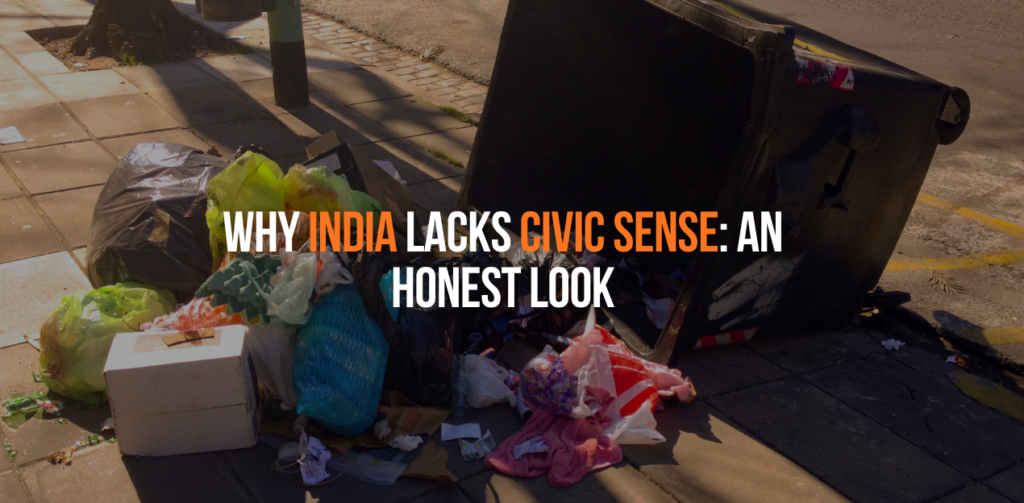
Staircases unswept. Common areas nobody touches. Streets that become dumping grounds. The difference between how Indians treat their own home versus a shared space is hard to miss.
The reason is not laziness. It is about ownership. What belongs to me, I take care of. What belongs to everyone, I ignore. Public spaces in India have never really felt like they belong to the people. They feel like government property. And government property has always felt like someone else’s problem.
A System That Taught People Not to Bother
Civic apathy in India was not built overnight. It was learned.
Decades of broken infrastructure. Complaints that went nowhere. Public systems that simply did not care. All of this taught people one thing: your effort will not change anything.
- Why pick up litter when the street looks the same tomorrow?
- Why report a broken drain when nobody shows up for months?
- Why care about a space that nobody else is maintaining?
This is not an excuse. But it is an explanation. In cities where dustbins exist and get emptied, where roads are maintained, people litter less. Not because they are better people. Because the surroundings signal that cleanliness matters here.

It Was Never Taught
Ask most Indians what they learned in school about taking care of public spaces. You will get a blank stare.
Schools teach civics as a subject. But it stays in the textbook. Nobody connects it to everyday life, to the street outside your building, the bus stop you use every morning, or the park your kids play in.
Children learn to clean their room. Nobody teaches them that the road outside is an extension of that same responsibility.
The Bystander Problem
Garbage piles up on a street corner. People walk past it every day, annoyed but certain that:
- Filing a complaint is a waste of time
- Cleaning it up themselves is not their job
- Someone else will eventually handle it
Nobody does.
As Moneylife pointed out in a detailed piece on India’s civic failures, Indians who follow every rule abroad often slip back into old habits the moment they return home. The environment shapes behaviour far more than personal values do.
What Actually Changes Things
Civic behaviour improves when three things come together:
- Infrastructure that actually works
- Rules that are actually enforced
- A culture where littering or breaking public norms is seen as genuinely unacceptable
Singapore is the example everyone brings up. Fines helped, yes. But what really built civic culture there was working systems, real consequences, and enough time for new habits to form.
India has had campaigns. Swachh Bharat made a difference in some cities. Indore is the clearest example of what is possible when enforcement is taken seriously. But one clean city does not fix a country. The shift has to happen street by street, building by building, and in the conversations parents have with their children about what it means to share a city with others.
Blaming Indians for lacking civic sense without looking at the systems that created this behaviour is too easy.
The harder question is what actually changes it. And the honest answer is not one campaign or one government scheme.
It changes slowly, locally, and only when people stop waiting for someone else to go first.
We may not be able to fix the street outside overnight. But we can take care of the space we live and work in. Clean India Project offers housekeeping services across Gurgaon and Mohali.
Frequently Asked Questions
Is lack of civic sense only an Indian problem?
No. Many countries face similar challenges. But India’s gap between how people treat their private space versus public space makes it especially visible.
Why do Indians behave better abroad than at home?
Because the environment shapes behaviour more than personal values do. When systems work and rules are enforced, people follow them.
Did Swachh Bharat Mission make a difference?
In some cities, yes. Indore is the clearest example. But the results have been uneven, and without consistent enforcement, many places have not seen lasting change.
Can civic sense be taught in schools?
Yes, and it should be. Most schools cover civic duties on paper but never connect them to real everyday behaviour. Countries like Japan make community responsibility a part of school life from a young age, and it shows.
Why do people litter even when dustbins are nearby?
Habit and the absence of any social consequence. When littering is normal and nobody reacts to it, there is no reason to stop.
What would make the biggest difference?
Consistent enforcement with real consequences. Not awareness drives, not posters. When breaking civic norms actually costs something, behaviour changes. Indore proved it.