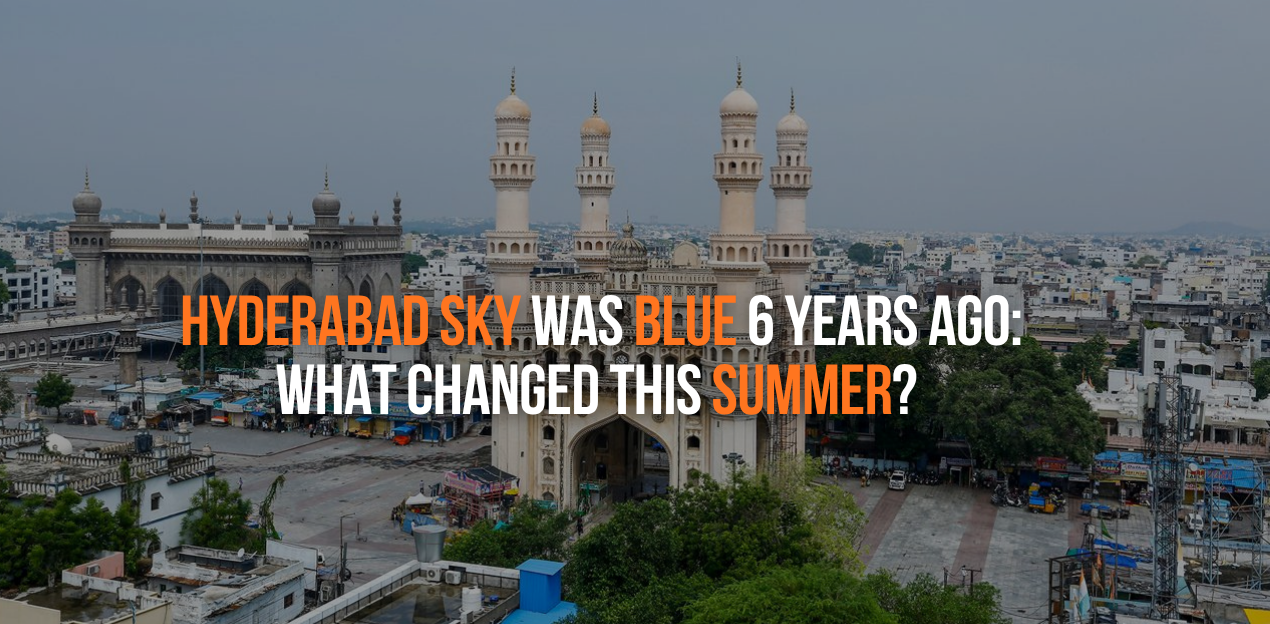
Ask anyone who has lived in Hyderabad for over a decade and they will tell you the same thing. Summers used to feel different. The sky was clearer. You could see further. The air did not sit on your chest the way it does now.
That is not nostalgia talking. The numbers back it up.
Hyderabad’s PM2.5 levels, the fine particles that get deep into your lungs and stay there, are currently running at more than five times the World Health Organization’s recommended safe limit. On bad days, the AQI crosses 150 and enters territory where even healthy adults are advised to limit time outdoors.
This is a city that once ranked among the cleaner major metros in India. So what happened?
The Growth That Nobody Warned You About
Hyderabad spent the last decade becoming one of India’s most desirable cities. HITEC City brought in global tech companies. Pharma clusters expanded. Infrastructure projects launched across the city simultaneously. Population grew. Vehicles multiplied.
All of that growth came with a cost that was invisible until it wasn’t.
India’s construction boom generates enormous quantities of dust from demolition, earthmoving, and cement mixing, particularly in cities undergoing rapid infrastructure expansion like Hyderabad. Drive through any part of the outer ring road or the newer corridors in the city and you will see it. Dust that settles on everything and hangs in the air long after the trucks have moved on.
Air quality in South Indian cities like Bengaluru and Hyderabad has shown a decline due to increased vehicular emissions and construction activity. The city’s vehicle numbers have grown significantly, and unlike Delhi, Hyderabad does not have the same level of public pressure or policy response around air quality.
Summer Makes Everything Worse
Hyderabad’s summers are brutal enough on their own. But heat does something specific to air quality that most people don’t know: it speeds up the chemical reactions that create ground-level ozone, one of the most irritating pollutants for the respiratory system.
Add to that:
- Dry conditions mean dust stays airborne longer
- No rain to wash particulates out of the air
- Higher traffic volumes as people avoid walking
- Construction sites running at full capacity before the monsoon
The result is that summer AQI in Hyderabad regularly spikes into ranges that health experts describe as harmful for everyone, not just sensitive groups.
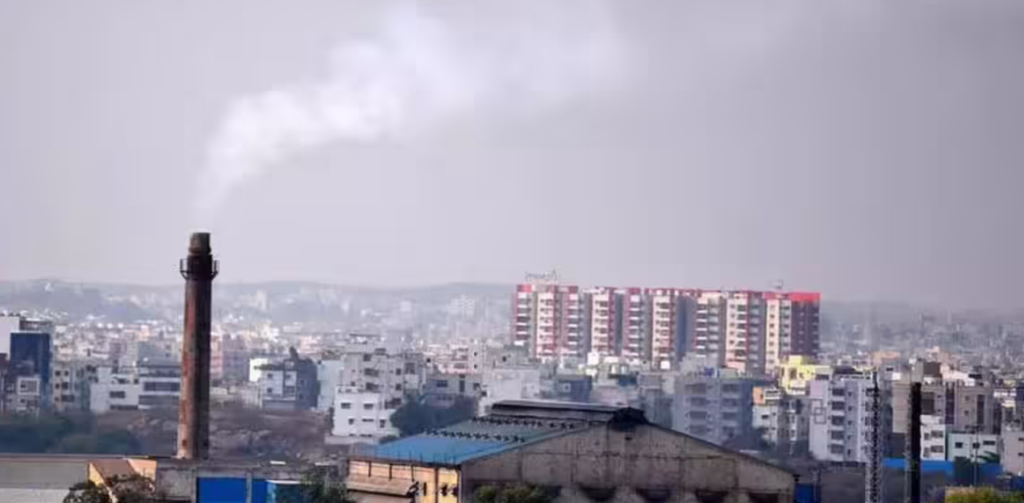
Several high-traffic and densely populated areas of Hyderabad have reported AQI levels between 200 and 300, which falls under the very unhealthy to hazardous category, raising serious health concerns among residents and medical experts.
The Sources Nobody Talks About
Vehicles and construction get most of the blame. But Hyderabad has two other pollution sources that rarely make headlines.
Thermal power plants to the northeast: The northeastern parts of Hyderabad experience higher aerosol loading, with NO2 and SO2 concentrations showing considerable enhancement over the northeast sub-region where numerous thermal power plants are located. When wind blows from that direction, the city absorbs it.
Waste burning: Open burning of garbage, common in areas where waste collection is irregular, releases black carbon and toxic particles directly into the air at ground level. It is one of the most damaging and most avoidable sources of urban air pollution.
What It Is Doing to Residents
This is not just about hazy skies. PM2.5 particles are small enough to pass through the lungs and enter the bloodstream. Long-term exposure is linked to heart disease, stroke, lung cancer, and reduced lung capacity in children.
Doctors in Hyderabad have reported rising cases of respiratory complaints, particularly among children and the elderly, during summer months. The connection between bad air days and increased hospital visits is well documented at this point.
What Can Actually Help
The city-level fixes, cleaner fuel standards, better construction dust norms, expanded metro use, are slow and political. But at the individual level, there are things that make a real difference:
- Track the AQI daily: IQAir’s Hyderabad page gives real-time readings. On bad days, reduce outdoor time especially in the early evening when pollution tends to peak.
- Invest in indoor air filtration: You cannot control what is outside. You can control what you breathe at home and at work.
- Limit early morning outdoor exercise in summer: Counterintuitive but true. Ozone levels and particulates peak differently across the day. Check before you go.
- Reduce vehicle use where possible: Metro, carpooling, or just consolidating trips. Every vehicle off the road during peak hours makes a marginal difference.
Hyderabad is not Delhi. It does not make the national headlines for pollution. But that is part of the problem. The city has been changing quietly, summer by summer, and most residents only notice it when their eyes sting or their throat feels raw on a hot April morning.
The sky was blue six years ago. It can be again. But that requires the city, and the people in it, to start treating air quality as an urgent issue rather than a background complaint.
You cannot control the air outside. But you can control how clean your home is on the inside. Dust, pollutants, and particulates settle on every surface. A regular deep cleaning in Hyderabad from Clean India Project helps keep your living space genuinely clean, not just on the surface.
Frequently Asked Questions
Is Hyderabad’s air quality dangerous right now?
On most days, AQI falls in the moderate to unhealthy range. PM2.5 levels are consistently above WHO safe limits, making long-term exposure a real health risk.
Which areas in Hyderabad have the worst air quality?
High-traffic corridors, active construction zones, and localities in the northeast near industrial clusters tend to record the highest levels.
Why is summer specifically worse for air quality?
Heat speeds up ozone formation, dry conditions keep dust airborne longer, and there is no monsoon rainfall to clear particulates from the air.
What is PM2.5 and why does it matter?
Fine particles small enough to bypass the nose and throat and lodge deep in the lungs. Long-term exposure is linked to heart disease, lung cancer, and cognitive decline.
Can indoor air quality be protected when outdoor air is bad?
Yes. HEPA air purifiers reduce indoor PM2.5 significantly. Keeping windows closed during high-pollution hours, especially evenings, also helps.
What is the quickest way to check Hyderabad’s AQI?
Apps like IQAir, AQI India, and AQICN provide real-time readings across multiple monitoring stations in the city.